About 1 in 10
women and girls of reproductive age worldwide live with endometriosis — roughly 190 million people.
WHO fact sheet, 15 Oct 2025 EndoAI
EndoAI · HoloSphere
EndoAI helps you record symptoms and pain as they happen, see what your own records show over time, and bring a clear summary to your next appointment.
Track it when it happens. Bring it when it matters.


Available now for iPhone and Android.
This opening HoloSphere is a visual metaphor: scattered observations finding their place. It does not depict anatomy or data.
Chapter 1 · Understanding the invisible
Endometriosis is a long-term condition where tissue similar to the lining of the womb grows in other places, such as the ovaries, fallopian tubes and the lining of the pelvis. It can cause inflammation and scar tissue, and it affects people very differently.
Sources: NHS (reviewed 27 Aug 2024); WHO fact sheet (15 Oct 2025). Checked 6 Nov 2026.About 1 in 10
women and girls of reproductive age worldwide live with endometriosis — roughly 190 million people.
WHO fact sheet, 15 Oct 20254–12 years
is the average time to diagnosis reported worldwide. Symptoms vary widely and can be missed.
WHO fact sheet, 15 Oct 2025A diary helps
NICE advises that keeping a pain and symptom diary can aid discussions with healthcare professionals.
NICE NG73, recommendation 1.3.3 (updated 11 Nov 2024)Other conditions, such as adenomyosis, fibroids, pelvic inflammatory disease and irritable bowel syndrome, can cause similar symptoms. The NHS advises seeing a GP if you think you might have endometriosis or if symptoms affect your everyday life, work or relationships.
Source: NHS — Endometriosis, reviewed 27 Aug 2024. This list is for awareness only and is not a checklist for working out whether you have a condition.Discover the anatomy · optional activity
The light has gathered into the anatomy explorer’s schematic of the pelvis. Select a structure here or on the schematic to light it up and read about it.
Explore three structures to complete this activity. It is optional.
Choose a structure to read what it does and how it relates to endometriosis.
A hollow, pear-shaped organ in the pelvis where a pregnancy develops. Its inner lining, the endometrium, builds up and sheds during menstruation.
Endometriosis is defined by tissue similar to this lining growing outside the uterus. The NHS illustrates small patches on the outside of the womb, as well as on nearby organs.
Glands where eggs form and where the hormones oestrogen and progesterone are made. They sit against the side walls of the pelvis, one either side of the uterus.
The NHS lists the ovaries among the places endometriosis is most often found. It can form cysts on an ovary, called endometriomas.
They connect the ovaries to the uterus, and eggs pass along them towards the uterus.
The NHS lists the fallopian tubes among the places around the womb where endometriosis is often found.
The tissue that lines the abdominal wall and covers most abdominal organs. In the pelvis it forms what the NHS calls the lining of the pelvis.
The lining of the pelvis is one of the places endometriosis is most often found.
A temporary store for urine, low in the pelvis behind the pubic bone.
Endometriosis sometimes affects the bladder. NICE lists period-related or cyclical urinary symptoms among the symptoms that should prompt healthcare professionals to consider endometriosis.
The sigmoid colon and rectum, at the back of the pelvis. The large intestine absorbs water and passes stool.
Endometriosis sometimes affects the bowel. NICE lists period-related or cyclical bowel symptoms, especially painful bowel movements, among the symptoms to consider.
The NHS says endometriosis is often found in areas around the womb, such as the ovaries, fallopian tubes and lining of the pelvis, and its diagram also shows patches on the outside of the womb. It sometimes affects organs such as the bladder and bowel.
NHS — Endometriosis; NICE NG73The everyday
Recurring symptoms are easy to live through and hard to describe later. These are the moments EndoAI was designed around.

Managing a meeting on a high-pain day, then trying to remember by evening how it actually felt.

Deciding what to move, cancel or ask for help with, often without knowing how tomorrow will be.

Describing symptoms that repeat across weeks and months, not just how today feels.

Ten minutes to explain months of experience, and the questions you meant to ask.

Referral letters, scan reports and notes, scattered across inboxes and drawers.
Images are illustrative and were created for EndoAI. They do not show real patients, and these scenarios are not testimonials.
Chapter 2 · Computational constellation
Eight weeks of example records, now in three dimensions: time runs left to right, each kind of entry has its own lane, and pelvic-pain entries rise with their 0–10 value. Turn the constellation, select points and explore the dates.
Synthetic example data — not a real person’s records
Kinds of entry
The table appears when JavaScript is available.
Every mark is something logged on one example day: pelvic pain, fatigue, bloating, a painful bowel movement, low mood or a period. On its own, a single day says little.
Synthetic example data — not a real person’s records
The table appears when JavaScript is available.
Explore a symptom story · optional activity
Follow a clearly fictional example through the constellation. Each part is written from the example data you can see, and moves the view to the days it describes.
Days without a record stay empty; nothing is guessed or filled in. A diary describes what was noted down and when, which is valuable in an appointment. It cannot show what caused a symptom.
Understand the patterns · optional activity
Turn on the Relationships layer in the controls above, then answer one question. There is no wrong answer here, only an explanation.
Entries recorded on the same day, or repeated on consecutive days, show co-occurrence or repetition in a record. That is worth discussing with a healthcare professional, but it is not evidence that one caused the other.
Chapter 3 · The science lab
Each experiment is real maths running live in your browser. Where an idea appears in EndoAI we say so, and we say what it cannot do.
Turn the dial until the spokes disappear.
Each floret turns by the same angle from the last and steps a little further out (Vogel’s model: radius c√i, angle i × θ). With most angles the florets form spokes and gaps; one angle avoids them.
Turning by about 137.508° is 0.382 of a circle, a number no simple fraction approximates well. Because no fraction fits, florets never line up into spokes, so they fill the space evenly, as seeds do in a sunflower head.
The golden angle, on the Science pageIn development EndoAI’s Living Garden module, not yet in the current app versions, grows decorative golden-angle petals with bounded growth (λ = 0.085). A bigger garden is not better health, and missing a day never removes a petal.
Golden angle and bounded growth on the Science pageTwo sources send out ripples. The height of the surface is the moving wave, the real part of ψ₁ + ψ₂. Its brightness is |ψ₁ + ψ₂|²: bright where crests meet crests, dark where crests meet troughs.
Educational only. EndoAI does not use quantum computing. The same arithmetic underlies the double-slit experiment in quantum physics, but quantum physics does not explain or predict endometriosis or its symptoms.
Planets move faster near the Sun. Kepler’s equation, M = E − e sin E, links time to position on an ellipse, and Newton–Raphson iteration solves it in a handful of steps. These particles move in equal time steps, so they crowd where the orbit is slow.
In development EndoAI’s Health Orbit module paces a marker around a decorative ellipse using your own recorded cycle length, and asks you to set one up until it exists. It does not identify cycle phases, ovulation or your next period.
Orbits on the Science pageIf fatigue was recorded on 3 of 4 days, is it really 75% of days? With so little data the honest answer is a range. Each point on the dial is a plausible frequency drawn from the exact Beta posterior. The dial runs from 0% at the lower left, over the top, to 100% at the lower right; the bright arc is the 95% credible interval and the gold needle is what was recorded.
In development The Pattern Discovery Lab reports recorded frequencies with Beta credible intervals, and this site’s Pattern Universe does the same with synthetic data. An interval is not a risk score and not the probability of having any condition.
Bayesian intervals on the Science pageSprings and networks, robust trends and an educational neural network are explained on the Science page.
The live 3D experiments need WebGL, which is not available here. The controls and readouts above still work, and the Science page has 2D versions of each demonstration.
Chapter 4 · Enter EndoAI
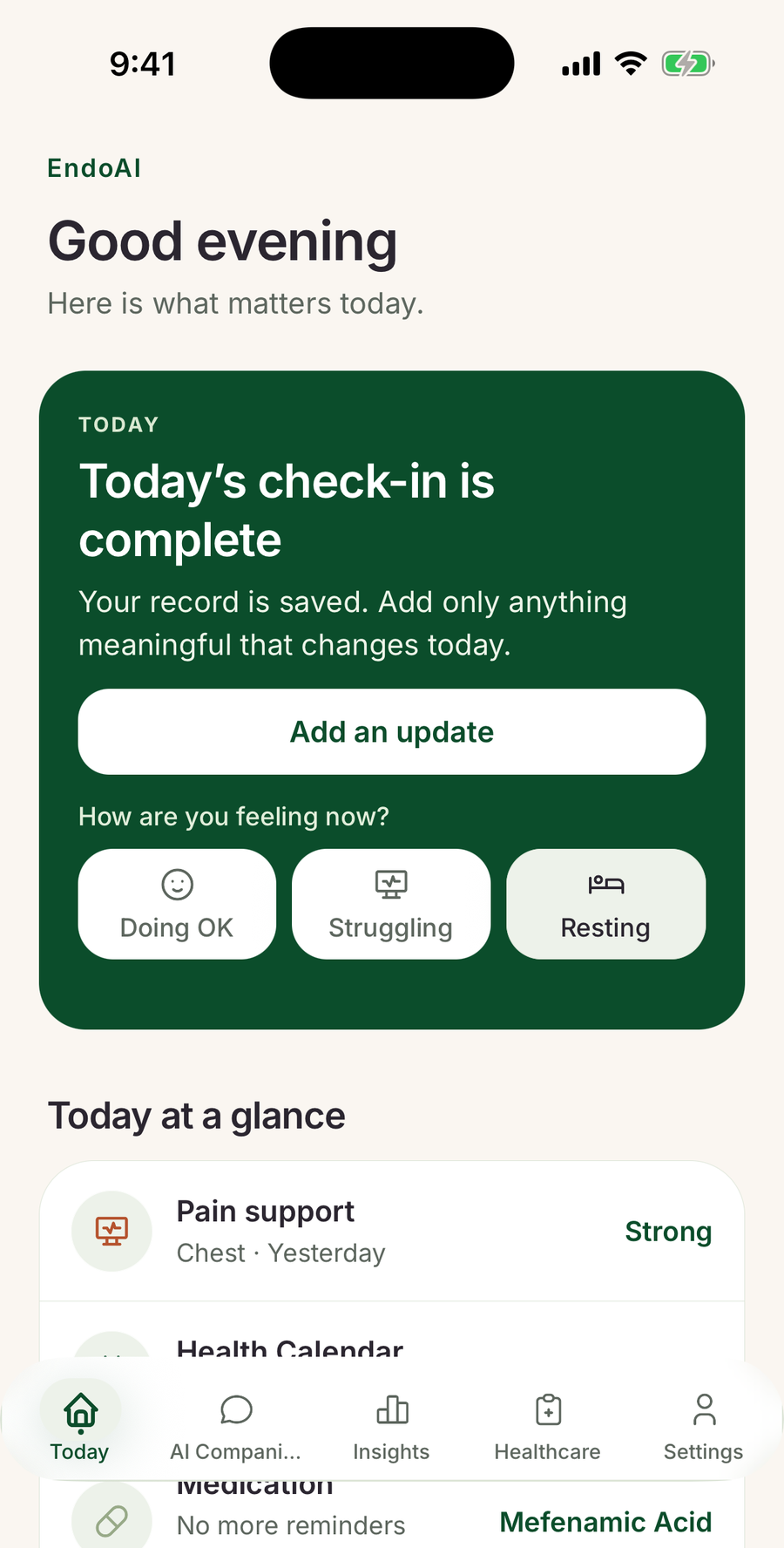
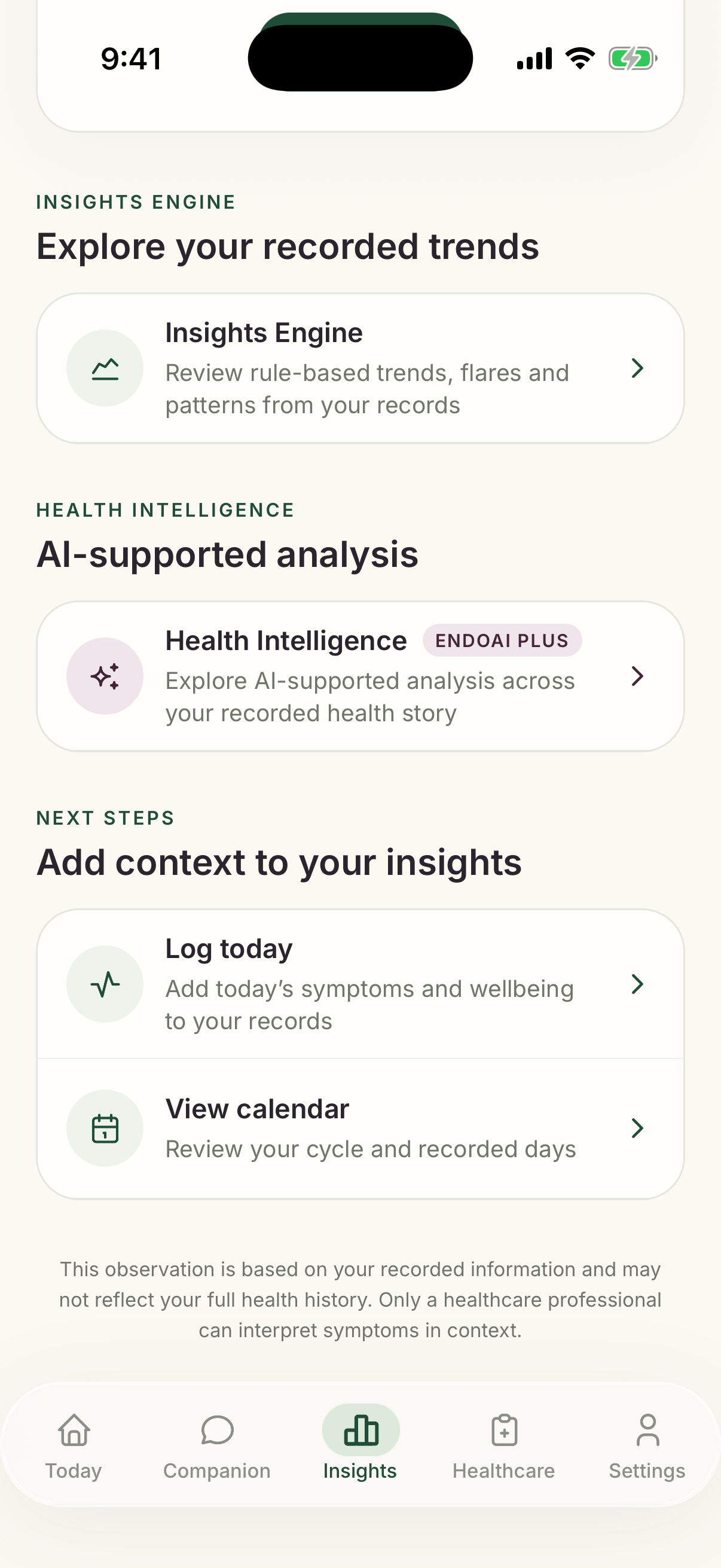
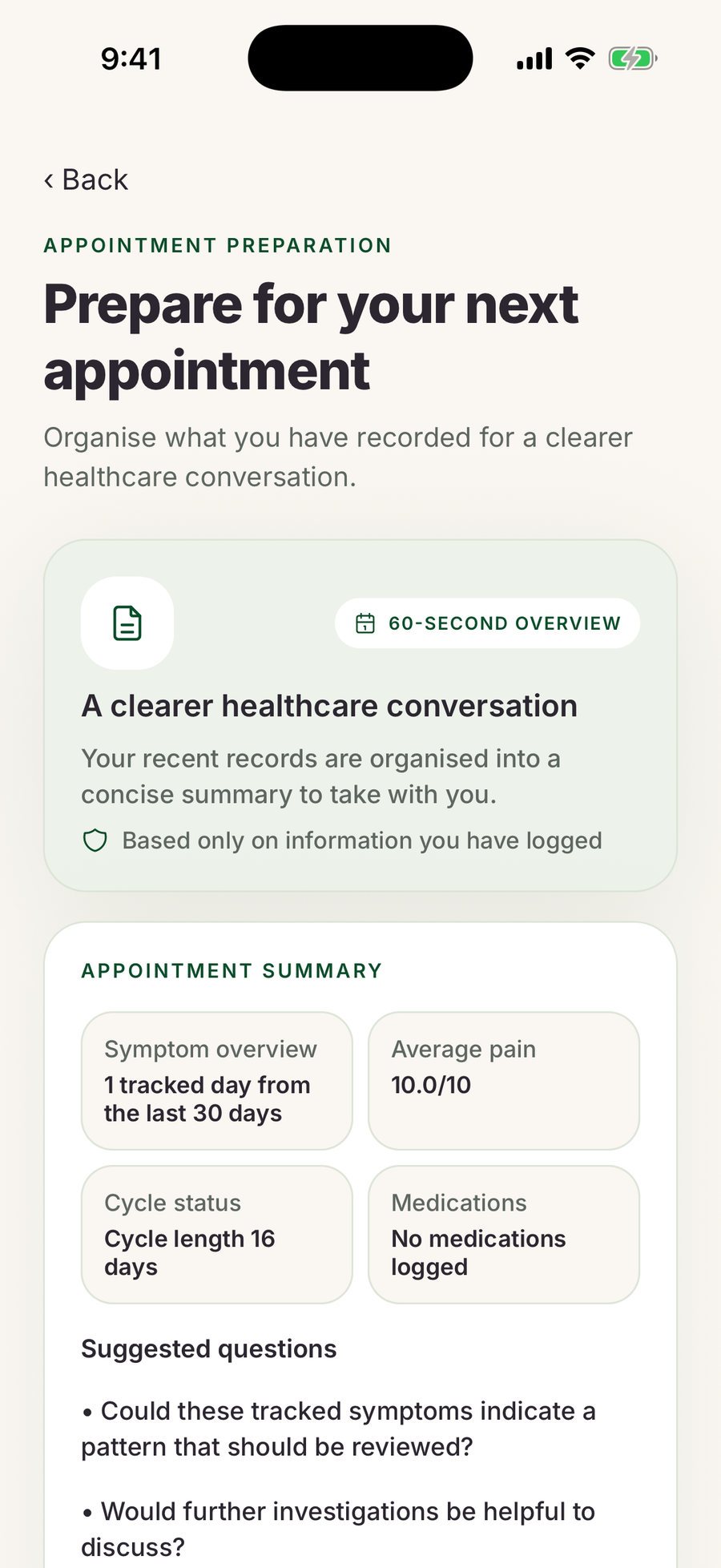
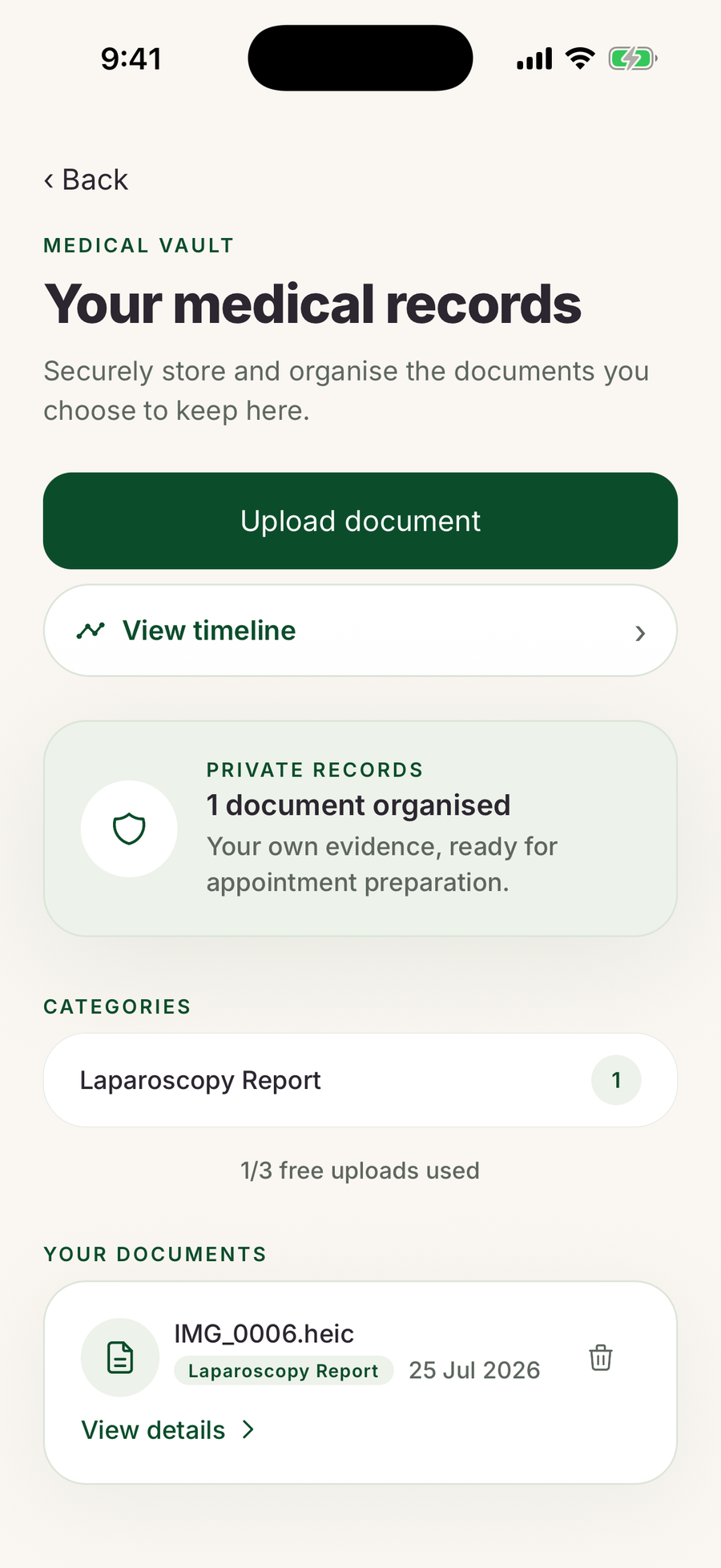
Four of these five views are genuine screenshots of the EndoAI app, and the body map is EndoAI’s own illustration. Features shown here are available in the app today.
Drag the cards, use the arrow keys, or choose oneSwipe the cards sideways or tap one

A quick daily check-in records how you are feeling, with space for the details that make a day yours. Small, regular records build a fuller picture than memory alone.
View the full-size screenshot
The body map lets you record where you feel pain, in your own words. It records your experience; it cannot show where endometriosis is or how much there is.
Why pain location isn’t a map
Insights brings symptom and cycle records together so you can review recorded trends. AI-supported observations are educational discussion points to review with a healthcare professional, not a medical assessment.
View the full-size screenshot
Doctor Prep organises your recent records into a concise summary based only on what you have logged, with suggested questions you can take with you.
View the full-size screenshot
Medical Vault keeps the letters, reports and documents you choose to upload in one place, organised by category and ready for appointment preparation.
How your information is handled View the full-size screenshotGet EndoAI
Free to download on iPhone and Android.
Try a sample journey
This sample runs entirely in your browser with made-up data. Nothing you choose is saved, sent or linked to any account, and it is not how the app assesses anything.
Prepare the conversation · optional activity
Choose the things you might note down before an appointment, then build an example conversation card.
NICE advises that keeping a pain and symptom diary can aid discussions with healthcare professionals, and the NHS encourages giving your GP as much information about your symptoms as you can.
NICE NG73 rec. 1.3.3; NHS — EndometriosisPrivacy and trust
Health information is special category data under UK data-protection law. EndoAI does not sell your data or share it with third parties for marketing.
Your records are stored in your account using Supabase cloud services. If you choose to generate an AI-supported summary, the information needed is processed through EndoAI’s servers by a third-party AI provider named in the Privacy Policy.
You choose which documents to upload. You can export your data, and you can delete your account and its records. The Privacy Policy explains what is deleted and the limited records kept afterwards.
This website collects no health information. The interactive demonstrations on this site run in your browser with example data and send nothing to EndoAI or anyone else. Discovery progress is kept only while this page is open.
Begin with you
Record what happens, when it happens. Look back over your own records with clear, honest summaries. Walk into your next appointment with your experience organised.
EndoAI is available on the App Store and Google Play. Some features are part of EndoAI Plus.
Questions? We’re here to helpYour discovery constellation
Nothing explored yet. Every activity is optional.
Progress is kept only while this page is open. It is never stored or sent, and every knowledge card can be read without playing.
Welcome to EndoAI. Your health story deserves to be heard. Track symptoms, organise your records, and prepare for conversations with healthcare professionals.
Explore the body map and record where pain occurs. This is an illustrative demonstration, not a medical assessment.
Look back at your recorded days, with space to notice patterns. Educational observations are for discussion with a healthcare professional; not medical advice.
Prepare the points you want to share at your next appointment. Keep the documents you choose to upload together in Medical Vault.
Your story matters. Every day. EndoAI supports your healthcare conversations and does not replace professional medical care.